
Rising designer Azaria Van Der Stok-Smallwood creates work that stops you in your tracks. She spoke to NYOTA about discovering her love for fashion, uplifting her community through her work, and her favorite piece she’s designed.
Who or what initially sparked your interest in fashion design, and how has that influence lasted and can be seen through your designs?
I went to a very alternative school my whole life called a Waldorf School, and these small, private institutions focus on the arts, the natural world, and teaching the brain to think in an open-minded way. So, I am four generations into Waldorf education in my family, and it wasn’t even a choice; my grandmother taught there, my mom went, and so did my sister, and the arts education I received there was very connected to the natural world. We started handwork classes in kindergarten and throughout lower school, where we learned to knit, crochet, and spin yarn. The school was directly across from a farm, and we would help take care of the animals and then we would collect the wildflowers that grew on the campus, and boil them down, turn them into dyes, and dye yarns together and it was such a normal thing in the education I grew up in to take from the natural world and create art with what was around you.
Obviously, as you grow up, education becomes more standardized, so when I decided what school I wanted to go to, I knew I wanted to go to an art school, and I really wanted it to be centered on fashion. I was obsessed with fashion because fashion was my medium of acceptance growing up between contradictory worlds. I was one of the only Black kids in my school, and I grew up playing AAU, with that world deeply connected to my culture and to people who look like me; then, in contrast, I grew up in the riding world, with equestrian as one of my two primary sports. In equestrian, I was always the minority or the only person who looked like me, and so I felt like I was always kind of playing dress-up to be received as the individual I wanted to come across as in whatever environment I was in.
At the time, I didn’t know whether that was code-switching or just a survival tactic as a youth. Clothes were my mechanism for acceptance. I could transform who I was to the world and how I was perceived based on attire. I was always going to be the Black girl in whatever environment I was in, in the riding world, in the private school, but if I could almost transcend all the other cultural emblems that would separate me, then at least I could garner acceptance in some format.
Knowing the power of clothing at that age drove me to understand how sartorial expression can be so powerful, and how we can harness it as a society to reflect broader structural issues. I think everything in my life has been kind of building me up to be a cultural orator through the lens of fashion, communicating my beliefs and my own experience and the experience of my community, but my communication style isn’t, you know, necessarily the written word. It’s the visual language of dress.
In your most recent collection, is there one design that sticks out as a defining piece that best describes what your work represents, what it is, and explains its significance?
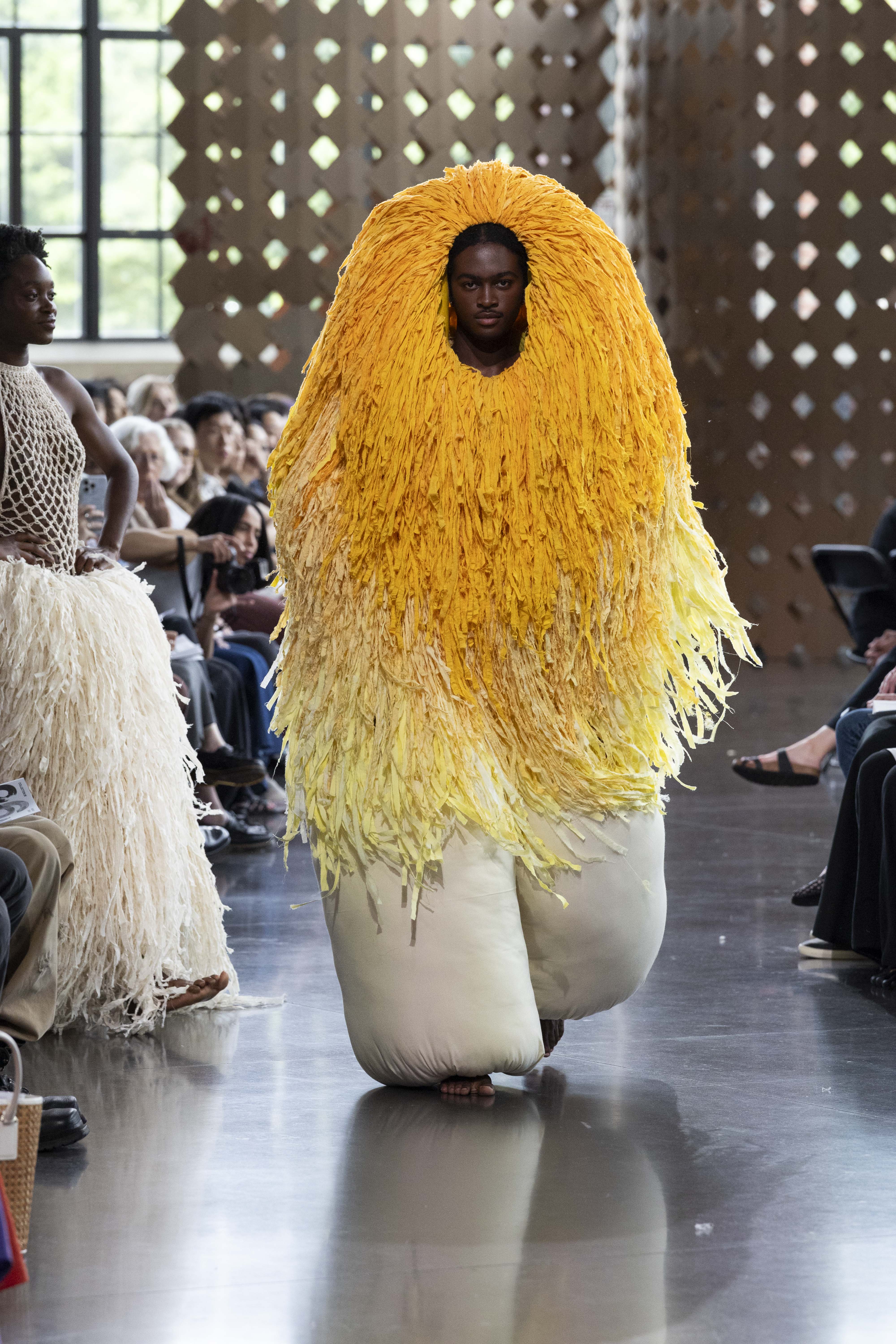
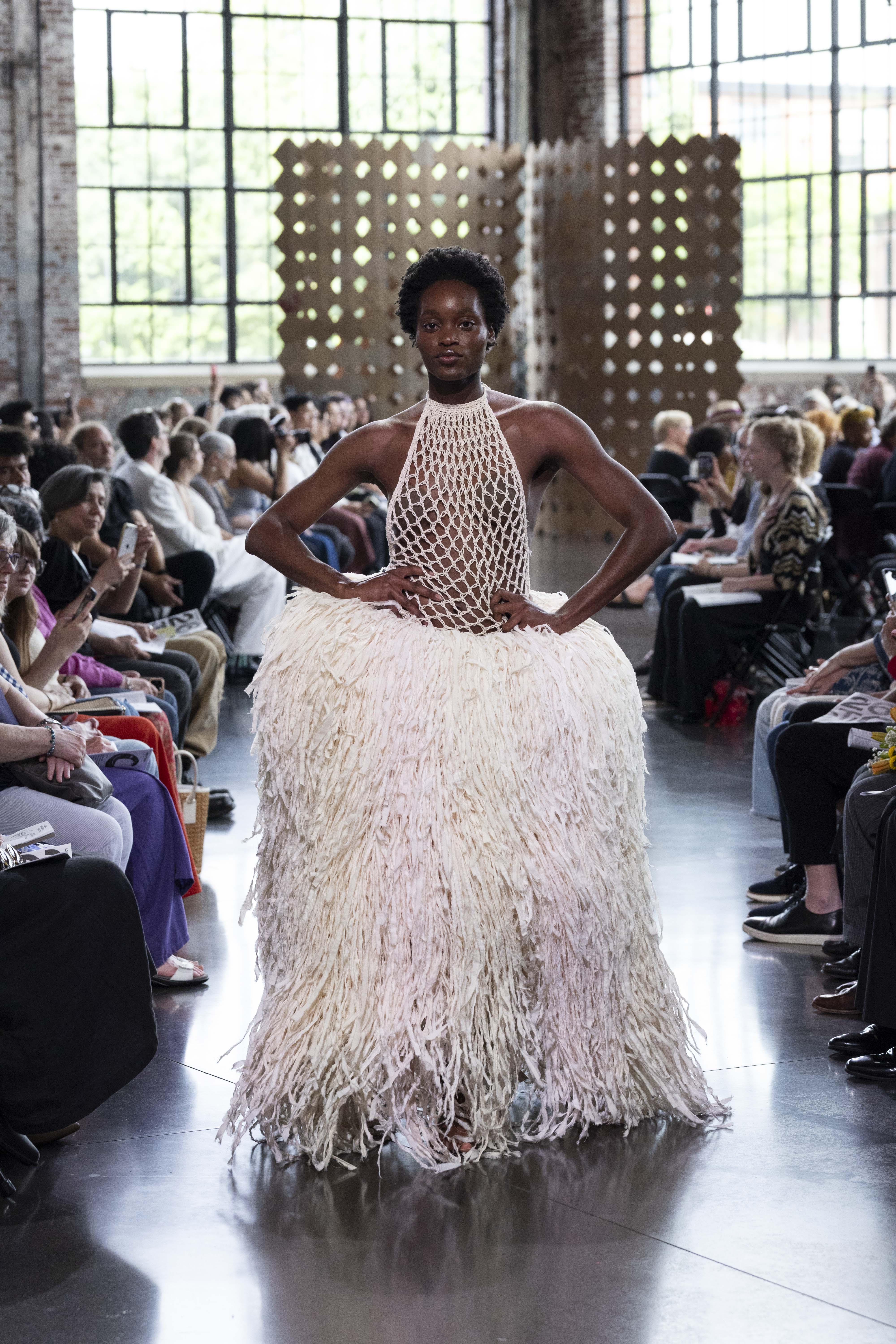
I have to turn to my favorite look in the collection, which is number two in my rundown. A beautiful model, Nene, wears it. The whole story behind it is actually quite incredible. It is a white crocheted fishneck, halter-neck dress with a really voluminous skirt made entirely from repurposed muslin scraps I collected throughout the year from waste created in our studio while creating pattern drafts. And I went up and down all the floors of my department building, collecting from all the different years, all of their scraps. I tore these scraps up into strips that really resembled the material qualities of raffia. Raffia is such a historically monumental material for the diaspora. It’s used across West African nations and tribes in so many ceremonially important garments and attire. It’s specifically connected to my familial ties to the diaspora. Having Nigerian family members, I am not of Nigerian descent, but I have a Nigerian family that hails from the Igbo tribe, and it’s specifically used within Igbo masquerade attire. It’s really a symbol of importance and cultural connection. So to take this waste product that was created by the apparel industry in general, but by my own studio at my primarily white institute, and repurpose it, to me, that was a bigger commentary on Black Americans’ historic connection.
Historically, Black America has turned societal scraps into refinement over and over again. We see this in edible innovations like infamous dishes like chitterlings, which arise from taking food scraps and turning them into meals that we consider soul food, and we see this throughout Black culture in so many manners: we’ve been given the scraps, the waste, the discarded materials, and we’ve turned it into something so beautiful and uplifted it. That’s what I felt; that process was so important to me. It was time-consuming. I would sit there for hours and hours just tearing these muslin strips, tearing this waste into something that, in the end, was so beautiful, had so much movement, had so many diasporic ties to culture, and had so many process-based ties to my culture.
Then, furthermore, the crochet has so many diasporic references that I feel in my bones. Part of me sits there, and I’m like, I don’t even feel like I need to make these academic ties, because the ties are the thing that is drawing me to do this. The history that lives in my body makes me want to sit there and do the same task over and over and over again for hours, and sit with myself while I’m doing that, whether that’s hours of crocheting by hand, whether that’s hours of tearing muslin repeatedly. The meditation I’m able to find during those times of rest, that is the ancestors speaking through me. That look, and then at the very end of that look, the crochet bodice, like a halter-neck top, the big raffia volume, taking up a monumental amount of space, which is also so important to me. But at the end of that, the very ties at the back of the dress are mussel shells that I hand-collected on the shores of Rhode Island. Throughout the collection, I use shells, and each one is individually hand-collected. Not a single one was bought. Every single one was collected on the shores of Rhode Island’s beaches.
When I look inward, I see a story that has been going on for time immemorial: a young Black girl connected to the geography she walks along the shores, collecting little items that have washed up, sparking joy, and turning them into art. I think that the same story could have occurred thousands of years ago. I’m just the current representation of that. I’m just the current orator. I’m not commenting on any societal structure that young Black women, young Black individuals haven’t commented on before. I am not doing something new and revolutionary by taking waste and turning it into refinement. But I give ownership, authorship, and creative rights to everyone who inspired it, to every author who inspired my work, to every tide that brought in a shell that I picked up, to every model that became the wearer and transformed my vision into something that spoke directly to their life, to every photographer who took a photo and the story continued on through their lens. This is all of our work. So that look definitely sparks a certain level of joy. But, I mean, all of them hold that for me.
With fashion being a tool for social justice, what conversations about the current political and social climate do you want to spark with your work?
Artists and designers’ primary function in society is to drive culture forward. It is to make people think outside their normative structures and systems, to stop and smell the roses, and to question things. We often think of artists as commenting on the world we see, but those commentaries drive the world we see into real change. When I see the language of dress and fashion, I think it’s so important. When I think about fashion, I think of perception in the world as a whole. When you see me, the first things you are going to note as an individual are going to be the color of my skin, my gender, and who you perceive me to be, and then what’s next up? Clothing, right? Am I an affluent Black woman from the Upper East Side? Am I the African American princess of them all? Am I an athlete? I am more than just the girl next door who always comes to the corner store in her sweat shorts, slides, and hoops. How I choose to portray myself through the language of clothing determines how you feel about me. I’ve known that for a long time because I grew up in the riding world.
I was poor. I was a broke girl on food stamps riding horses with multimillionaires. But if I dressed the dress, talked the talk, and walked the walk, nobody questioned it. As soon as I realized that, I said, “You know what? The language of dress determines so much about society.” It is a commentary on the broader social structures. We see it now with the rise of conservatism. We see how that’s influencing dress. We see it more in climates where we are moving in a more progressive, liberal way. I always think it is inherently political, and it is; I mean, I think it’s my duty to always comment on the broader topics of the world that matter to me and affect my community.
Now, of course, it makes sense coming from me, right? Do I think that it should be all artists’ responsibility to fight for something? You don’t have to care about what I care about. If you want your topic to be climate change, if you want your primary focus to be immigrant rights, if you want it to be trans rights, I’m happy for you. Everyone picks something that matters to them. But I hope all artists feel inclined to use fashion or other mediums to really drive society forward. I definitely feel a pressure and responsibility to.
There aren’t that many young Black kids who have the privilege of taking the risk to pursue art. Art is still treated as a luxury in our society. Art education, specifically, is separated as something that is primarily set aside for the wealthy, for the white. So when I, as a young Black low-income individual, have the opportunity, the privilege to enter those spaces, I’ll be damned if I don’t try to uplift my community and my community members so that all of their voices have a pedestal to stand on and have a space to be heard, because our voices haven’t been heard. So, do I think it’s a responsibility that everyone should have? A hundred percent. Do I think there are plenty of artists and designers who are much more worried about money than anything else? Absolutely.
But I’m not, I’m not interested in money. I already took the risk to go into the arts. I struggled. I got a bunch more years of struggle prepped and loaded. I’m still young. I’m still okay sitting here and making the choice that I’m going to go after the thing I love, even if that requires me to work the 9 to 5 and then the 6 to 3 a.m. after and have a second job, wait tables, and do what I need to do to be able to be an artist, because it’s a luxury to be an artist. It’s a luxury to come from where I came from and be able to take the risk on yourself to pursue your dreams like this. Not every young Black kid has that opportunity.
What are your next steps as you emerge into the industry?
My next steps as I enter the industry are really trying not to allow myself to be flattened at all by the greed that can kind of be at the heart of this industry. I never want to stop making the goals I’ve stated at the center of the work I do. So it’s about learning what I can from the industry, and then utilizing that to change it.