

With Fin, Nora Mae introduces herself on her own terms. Building a world rooted in emotional honesty, old Hollywood glamour, and quiet introspection. Across the album, she explores love, loss, vulnerability, and reinvention. Mae spoke with NYOTA about balancing legacy with individuality, creating a project that feels timeless yet contemporary, and why she’s more interested in building worlds than chasing algorithms.
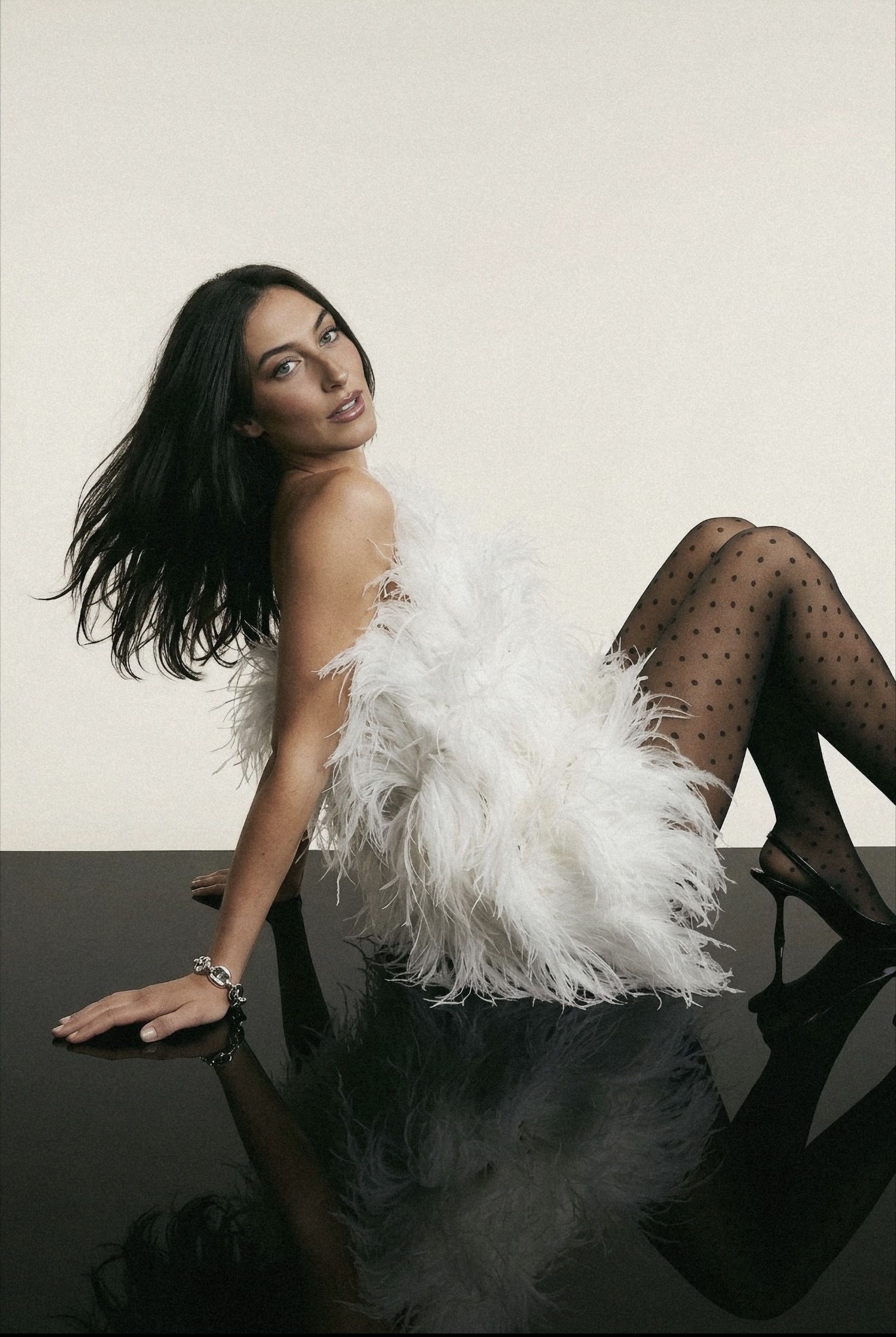
Your introduction to most people may include the fact that you’re Eartha Kitt’s granddaughter, but Fin feels intentionally intimate and self-defined. At what point did you feel like you moved from “inheriting influence” to actually defining your own voice?
I think there’s always going to be an awareness of the legacy, but the shift really happened once I became more confident in myself and my vision as an artist and believed I deserved my own seat at the table, apart from my grandmother pulling out the chair for me. I stopped trying to prove that I was “worthy” of it and started focusing on making something authentic to that vision. It’s not an attempt to recreate another era or step into someone else’s shoes. Once I leaned into my own instincts, my own writing, my own perspective on love and loss and performance and identity, I stopped thinking so much about comparison. Legacy became less of a shadow and more of a foundation. A very real part of the story, but not the whole story.
When you come from such a powerful artistic legacy, how do you honor that history while still giving yourself permission to create something that feels entirely your own?
I think honoring history is less about imitation and more about taking what serves you to pay homage, to be respectful of the path laid before you, without sacrificing your own individuality in the process. To me, it was more about honoring her essence. My grandmother was fearless, even in her fear. Vulnerable, even in her strength. A commanding presence, even in her silence. Those are the parts I feel most connected to creatively and spiritually. I had to give myself permission not to over-contextualize my work through lineage and just let it exist on its own. It so happens that I’m naturally inspired by old Hollywood, jazz, theatricality, storytelling… but this project still feels contemporary and deeply personal to me. I’m not interested in making something referential for the sake of it or as a gimmick. I wanted to build a world that felt immersive and emotionally honest to myself.
Fin seems to explore growth, closure, and emotional evolution from a place of reflection. How did you approach writing about those themes without feeling like you had to explain everything too literally?
I’ve always been more interested in capturing the emotional core of something than recounting events exactly as they happened. Memory can be selective and cinematic. Certain moments become exaggerated, others blur together. So when I was writing the album, I didn’t feel a responsibility to over-explain every detail or spell out every reference. I wanted the album to feel experiential, almost voyeuristic at times, where listeners could project themselves into it. Some songs are very direct, others are more abstract or symbolic, but all of them are emotionally real. I think there’s power in allowing space for interpretation. Sometimes saying less actually reveals more.
The word “fin” signals an ending, but this is your beginning. What does that contradiction mean to you? Was this album more about closure, or about clearing space for what’s next?
The contradiction is the entire album for me. Endings inherently represent new beginnings, and to me, this album feels like the fade-to-black at the end of a chapter. More than anything, the album documents the collapse of an older version of myself just as much as, if not more than, the actual relationship itself.
The person who started writing these songs is very different from the person releasing them now, not because I feel like I fundamentally changed as a person, but because experience naturally changes your emotional perspective. A lot of that just comes from growth, intention, reflection, therapy, and living life.
So yes, there’s closure in it, but I don’t think closure necessarily means answers or resolution. It’s more about acceptance and understanding that something can end and still remain incredibly meaningful and beautiful. And in clearing space for that ending, it naturally creates room for a new chapter, creatively and personally.

Growing up around such a strong sense of performance and presence, what parts of that translated naturally into your own artistry, and what did you have to actively unlearn?
I grew up very aware of how performance, both on and off stage, is essential to being a fully embodied artist. I love creating worlds around the music, not just songs, because people connect to the presence of an artist just as much as the work itself. The songs can be good, but it’s the full experience, the perspective, the identity, the world around it, that makes people emotionally invest.
I’m collaborative by nature. I don’t need every idea to be mine; the best idea wins. But I think the thing I had to unlearn was overvaluing outside opinions, especially in an industry where everyone constantly has insight into what you “should” do creatively or personally. Whether it’s A&Rs, industry people, or in the studio with producers and writers, I listen to everything and consider everything. I take it all in. But ultimately, I’m the one who has to live with the decisions as an artist, so it has to feel true, and it has to feel aligned. Nobody has all the answers; we’re all constantly learning in real time. Everyone’s kind of faking it until they make it. Our intuition is usually very strong and very loud; you just have to listen.
There’s a quiet confidence in how you approach vulnerability on this project; it never feels like overexposure. How do you personally define the line between honesty and emotional restraint in your music?
Vulnerability, to me, is less about revealing everything and more about conveying an emotional truth. There are absolutely details and experiences woven into these songs that are deeply personal, but I still care a lot about restraint and perspective. I’m much more interested in tension, implication, and atmosphere. I don’t think emotional honesty requires total exposure. In fact, I think mystery is part of what makes art linger and allows people to naturally see themselves inside it. When I listen to a song that really affects me emotionally, it’s rarely because there are exact times and dates. It’s the feeling it invokes. Just a melody or certain instruments alone can bring up emotions. That’s why film score is so fascinating to me… how music works that way psychologically.
Your sound has been described as “timeless but modern.” Can you tell me more about what this balance means in a practical sense for you? What artists, textures, or moments in music helped you find this balance while making Fin?
I’m really inspired by music that feels untethered from a specific trend cycle or timeline. There are moments on the album that pull from different genres and different decades, but it still feels contemporary. This doesn’t even scratch the surface, but I was listening to everything from Nancy Sinatra, Billie Holiday, RAYE, Stephen Sanchez, Amy Winehouse, The Stones, Tina Turner, Hozier, Billie Eilish, James Blake, and a lot of film scores while making it.
I wanted this album to exist in that space where something can feel classic and modern simultaneously, like it could belong to multiple eras at once. Sonically, we made very conscious decisions to preserve a more live feeling with live instrumentation, intentionally leaving certain imperfections in. I also avoid making hyper-specific references to technology, social media, or things that immediately timestamp the music. There are no expletives and very little that places it firmly inside any specific point in history. It became a fun exercise for me to identify all the subtle ways you can make something feel timeless without it feeling detached or costume-y.
As you move from releasing music to performing and being seen more publicly, what feels most important for people to understand about Nora Mae as an artist right now?
I want people to see Nora Mae as a world-building artist. Yes, it’s the music, but it’s also all of it. I love creating these immersive little worlds within the world for people to step into. Nora Mae is an extension of me, almost like a caricature of certain parts of myself. It’s human and grand at the same time, which I think is the most human thing someone can be.
I’m very much a body-of-work artist, an album artist. I’m not really interested in putting out singles just for the sake of staying visible or feeding an algorithm. I’d rather disappear for a year and come back with something intentional than release things that don’t serve a bigger emotional or creative purpose. I always want there to be a reason something exists, and I hope people feel inclined to come along for the ride.
![Manasseh Drops ‘R&B[eyond],’ an Ode to His Younger Self and a Celebration of the Expansive Nature of Music](https://nyotamagazine.com/wp-content/uploads/sites/28/2026/09/NYOTA-FEATURE-IMAGES-NEW.png?resize=768,768 "NYOTA FEATURE IMAGES NEW")
