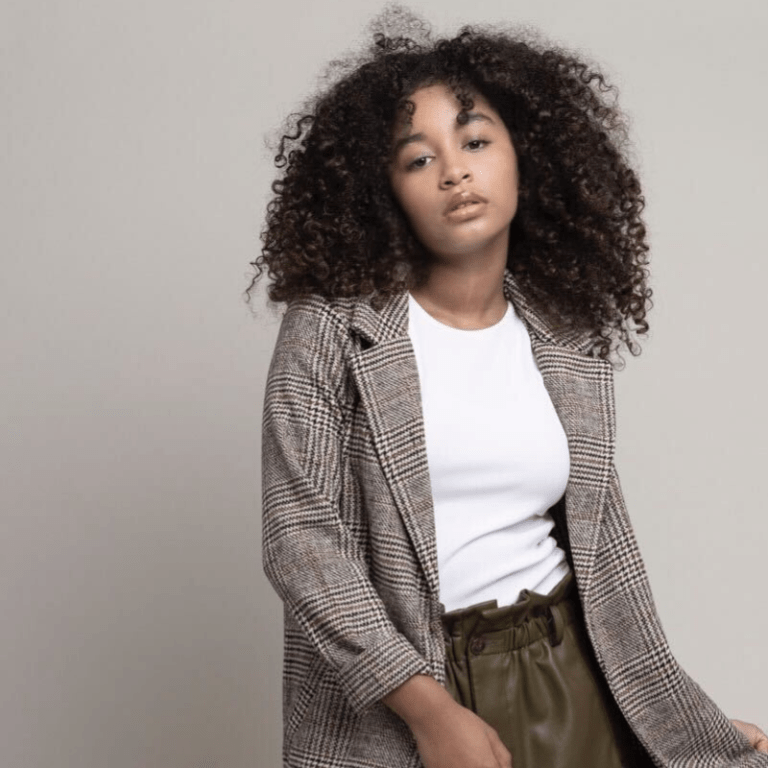

We’re going into the NYOTA archives to find some of our favorite interviews that weren’t originally shared on the site.
Laya DeLeon Hayes, a BAFTA award-winning actress, has been steadily building an impressive resume of projects since she landed the role of Dottie “Doc” McStuffins at age 9. The actress hopped on the phone to discuss when she caught the acting bug, her role as Vicaria in “The Angry Black Girl And Her Monster,” and what she hopes audiences take away from the film.

You had the incredible opportunity to voice Doc McStuffins when you were 9 years old. What led you to acting at such a young age?
Well, I was raised in Dallas, Texas, and that’s kind of where I caught the acting bug when I was around, I think, 8 years old. Before acting, I did a whole bunch of stuff. I was never a big fan of sports, so I started with gymnastics and ultimately that led to cheerleading, and that led to dancing, and that led to singing, and I had loved performing, so I would do a lot of recitals, talent shows, and children’s theater in elementary school, and I loved it. I remember getting off the stage when I was 7 and going up to my dad and being like, ‘I got to get back up there.’ So it kind of all stemmed from my love of performing. On top of that, I was a pretty dramatic child and a very theatrical child, so I guess it was my love for the theatrics. In third grade, I ended up doing the morning announcements at my school, and it was put on camera for the whole school to see. Sometimes, they would have us play certain characters, or we would dress up as people from history. I dressed up as Rosa Parks one day, and I just loved it. Also, I was a ham. Preschoolers would come up and be like, ‘I saw you on the morning announcements,’ and I was like, ‘Ha ha, yes, you did!’ So after that, I asked my parents if I could start doing acting lessons, and I did acting lessons for about two years, along with some theater programs in Texas. On top of that, I was really interested in commercials and being on TV, and there’s only print work in Texas, and I was very lucky that my parents were so supportive. So when I was like, I really want to do commercials and be on TV, they were like, well, let’s give you a shot, let’s make your dream come true. So we ended up moving to Los Angeles when I was 9 years old, and the rest is kind of history.
You’re a seasoned actor with incredible voiceover and live action projects under your belt. Do you feel that you use different acting muscles when it comes to voiceover work vs. live action work?
Oh, completely. I mean, it’s kind of a whole other realm in a lot of ways. There are, of course, similarities because at the end of the day, you’re telling a story and you’re playing a character, but there are certainly different muscles to use. The main thing is you’re using your vocal cords differently than you would be in any live-action or on-camera project. I was very lucky because my first big opportunity was Doc, and so I learned everything just being in a recording booth. I would watch actors like Loretta Devine and Lara Jill Miller because they gave me the opportunity to sit in on some of their sessions and just watch what they did. I learned so much just from being in that environment and learning from our directors there because I did that for about six years. I would say the biggest muscles you’re using are your vocal cords. I mean, you’re going to have to be drinking a lot more tea than you’d have to drink when you’re doing anything on camera. Then on top of that, because they’re not showing your face and it’s all behind a microphone, you have to be even more expressive or 10 times more expressive, 10 times more physical in your performance than you would have to be on camera, because you’re kind of overcompensating since people aren’t seeing your face.
I worked with people who also had never done voiceover work and had only done film or TV acting, and it was so interesting to see because you’re doing it for six to eight hours straight, and people will be exhausted afterward because you’re exerting just as much energy as you would be exerting on camera. The only thing is you could be giving an amazing physical performance, and no one could see it, no one’s watching it. So yeah, a lot of that you’re going to have to overcompensate so that it translates over a microphone as opposed to on camera, you don’t really have to do that. I mean, there are plenty of things. There’s also the fact that when you’re in a recording booth, it’s much more isolated than when you’re with an entire cast and you’re able to go off of people’s chemistry, a lot of the time for projects that I’ve done, you’re in a studio by yourself and just with the director or writer, so again, a lot of those things you have to prep differently before you go into a booth versus a set.
Currently, you can be seen in The Angry Black Girl and Her Monster. In it, your character, Vicaria, pushes down her grief through working on curing death. How did you go about preparing for the role and getting into the character’s headspace?
I mean, she’s certainly determined and ambitious. She kind of almost blocks out or doesn’t realize just how traumatic these things have been for her, and she is using her love of science as a way of healing, and then ultimately her anger and then trauma and sadness manifest into this creature, who we meet as Chris. So it’s definitely a dark headspace to be in, but when I read for Vicaria, I was so intrigued by the character. I had never read for anything or auditioned for anything that complex. I had never really seen a character that could be brilliant, innovative, so smart, so bright and youthful, but also at the same time be so flawed and try to put the pieces of her family back together and not have all the answers. She felt like this complete three-dimensional human being, and when you are a young actor, at the time I was 17, the roles that you get, especially being young and Black, but as a teen actor in this time, it’s very much the angsty teen or there’s a lot on social media, you know, or they’re like an influencer, and that was kind of the opportunities that I was getting. When I saw Vicaria, I was just like, whoa, this is different, this actually has meat on its bones, and I could do something with it.
Ultimately, when I read the script and saw the way that grief was dealt with and loss when you’re young, I definitely related to it. I mean, I haven’t experienced too much death in my young life at this point, but for what I have experienced, I could fully relate to how she couldn’t figure out how to truly heal. In a way, it was freeing because obviously she goes to extremes to be able to do so, but in so many ways, it’s like she’s truly trusting her instincts and what she fully believes in and marching to the beat of her own drum. As someone who doesn’t think like that or is a bit more analytical before I do anything, it was so freeing to just feel everything that Vicaria was feeling. So a lot of the prep work that I did happened at home and was super isolated to anything that happened on set because Bomani, our writer-director, and obviously our other wonderful cast members as well, they made that space just feel so safe, and I was there for every single day, so there wasn’t so much time to go back to what I had written and think about this or think about that, so much of it was staying in the present moment and just feeling exactly what Vicaria was feeling in any instance. Again, it was freeing as an actor. So prep work was reading Frankenstein and when you build these characters up from the very beginning, you figure out their relationships that they have with each character in the movie, even the ones that we don’t really get to know very well, like her mom or Chris, and even Kango, you honestly don’t get to see a lot of their relationship before Chris’s death, so it’s just kind of building all of that up so that by the time I get to set I’m able to just throw it out the window and stay in the moment.
After filming, was it hard for you to leave the character behind, or did you not find it difficult to separate yourself?
I was in the headspace for 20 days straight, that’s not a long time to make a movie. So that was one thing to just kind of be consistently in that for a long period of time. I hadn’t experienced that before, but I was waking up as Vicaria and going to sleep as Vicaria, just with how long the hours were. When it came to the end of the film and getting out of it, it wasn’t too difficult because again, it wasn’t an eight month filming process and I also had time on weekends to hang out with my family as well, and I do think that, that was healthier for me to step out of it for a second and come back or like to be Laya for a second and then come back because when it’s time to work, it’s time to work. Truly, we would have only one day, if you’re doing an overnight shoot on a Friday night, like your Saturday is gone. So we would have like one day to just breathe, and I would fully take that breather so that by the time we ended it, I didn’t stay in it for too, too long. I will say, though, I did go on vacation afterward.
Outside of the horror/sci-fi elements of the film, it also deals with violence within the Black community, violence against Black bodies, racism in schools, and more. Was the opportunity to explore all of these themes one of the reasons why you wanted to be involved in the film?
Oh, completely, completely. There’s so many different layers and messages to this movie. Every time that I watch the movie again I’m able to take something new from it, and that’s a testament to our writer and director, Bomani, who was able to be so gracious and show the true horror of what it’s like to be Black in America, but also at the same time show the beauty and humanity of being Black as well. So, of course, it was a huge part in taking on this project. I wanted to play Vicaria, and I was interested in the character, and then, reading the script and reading the title, at first, I was so hesitant. I was like, oh, what am I going to get into? And it was having meetings with Bomani and really seeing and understanding his vision and truly getting it because I do feel like on paper when you read it, it’s a bit hard to grasp, and then you read it again, and it’s like, oh, wait, this is something different. And then you watch it on screen, and it’s a completely different experience.
So any time that I can tell our stories authentically and truthfully and play characters that I haven’t played before and I haven’t seen before, and the opportunity to also work with young Black filmmakers, you just, you can’t really pass up on that. So all of that kind of went into me wanting to take on this role. But I really do believe that this story is so interesting and something we haven’t seen before. I mean, there’s plenty of novels from the 1800s where Black people are not even included in the narrative, and Bomani was able to create something that shows our truth and our authenticity and put it in the eyes or in a tale that many people are familiar with, but maybe haven’t seen it like this before. So that was all kind of going on in my head when taking it on. We just don’t get original projects either right now, and to see something weird and unique was and is truly, truly exciting.
The angry Black girl stereotype is one that permeates our culture and is often used to paint Black women as hostile and aggressive, and that stands out in the classroom scene where Vicaria gets pinned down on the ground. Can you talk a bit about filming that scene and how you approached it?
I mean we’re human at the end of the day, it’s such a funny thing it’s like those two phrases ‘Angry Black Girl’ and ‘Monster’ have been projected onto Black people via people who aren’t of color, and that’s played a part into how they want to categorize us or put us into a box and ultimately is the reason why we as Black people feel the need to code switch or make sure we don’t do anything that may put us in that box. In that way, it’s dehumanizing because we feel like we can’t even be angry without having that label put on us. So going into that scene, it’s so interesting. I remember reading the script, and I was like, she’s a bright young girl, and she’s innovative, and she has questions, and that’s it. I mean, what’s so great about it is Bomani’s sister, I mean, it’s unfortunate, but also a cool tidbit about the movie is that it’s based on Bomani’s sister’s story, and what happened when she was in grade school. She actually did call the teacher Miss B-I-T-C-H.
So I got to talk with Bomani’s sister about her experience, and she was absolutely lovely, but just being able to hear about it firsthand was really great, and then on top of that I was the type of kid in school that my dad would have to come to the school and basically do the exact same thing that Donald did with that teacher. So those microaggressions, and again those categories that they want to box us into, just don’t work. We’re human beings, and that’s that, but a lot of the prep went into having conversations with Bomani’s sister and even going back to the conversations my dad would have with our assistant principal at my school in Texas. But microaggressions are one of those things you, as a Black person, are obviously going to encounter, and being able to tackle that and see it on screen was really impactful. It’s still one of the most impactful scenes when I watch it in the movie because, again, I had never seen it depicted like that before.
What do you hope viewers can take away from the film, and what conversations do you hope are started after people watch the film?
Again, there’s so many messages in this movie. I think the biggest one I hope they are able to talk about or have a conversation about after seeing it is realizing who the true monster is in this movie, and not just in this movie, but also within their own lives, within the Black community. I hope that they’re able to get away from even the jump scares or the horror aspect and really empathize with these characters and try to get down to the root of the issue and the truth. Along with that, I hope that they are also scared. I mean, it’s a genre film, so I do hope that they also like the jump scares, and maybe they get a good scream or something out of it. But I hope they leave with something much more impactful, and I hope that they may be able to recognize, especially if you’re not a person of color, maybe how you’ve been a part of the problem and try to figure out a way to at least have a conversation or start the conversation to be a part of the way we can progress forward.
What advice do you have for aspiring actors?
Oh gosh, there’s so much. I would say, if you want to start acting, watch as many movies as you can, and I would say to train if you are able, and if not, study. You can find scripts online, and then on top of that, don’t let anyone put you into a box or tell you what you can or can’t do because you are absolutely capable. Even one of the biggest takeaways for me as an actor who has been in this industry for a good amount of time is just having that confidence in knowing what I’m capable of, and nobody else’s opinion really matters. If you truly believe that and you’re able to build and grow upon that belief, then nothing’s really in your way. So if you feel you’ve got it and you’ve studied and you’ve worked hard, then keep that mentality and that belief in yourself. I really think that’s what pushes us forward, especially being in a creative industry.
This story first ran in Issue 32. Read more from the issue here.