
With a plan to revive the New York City music scene and create a space for musicians to come together and build community, Danny Ross, a musician in his own right, created Anti Social Camp. Ross spoke to NYOTA about breaking into the music industry, taking Anti Social Camp across the pond, and The Beatles sparking his interest in music.
Take us back to the beginning of your own music journey. What initially sparked your interest in songwriting and producing?
I know this is a controversial take, and no one has ever said this before, but The Beatles were the very reason I became a musician in the first place. Watching The Beatles Anthology, which is about to relaunch around the time this comes out, inspired me to have a life in music. I was watching, thinking, these people are creative, playful, kind, generous, and can have a life in the arts. And I’d like that, please. Of course, it was much harder than one would initially expect, but here we are.
Breaking into the music industry is no easy feat. When you were first starting, did you have a mentor or someone who really championed you and your work?
Being an artist is so tough, and creatives, artists, songwriters, producers don’t have enough people in their world, in their support system, to say, ‘You’re brave. You could do anything, and you’ve chosen one of the hardest things to do, and so, you know, good job.’ Instead, it’s the opposite, right? Society derides artistic types as not serious. We’re all trained to work in finance or in something more stable, like law or medicine. Parents try their best but can’t really understand. Music is a calling. We are on our own, and we need to be surrounded by our people. And in a place like New York City, for example, or really anywhere that you live, it’s hard to find your people. That was one of the reasons I started Anti Social Camp: to create a community, offer beneficial opportunities, make it completely free for artists, and, more than anything, connect people with each other. I was a songwriter–producer in the scene here, and the common complaint I heard was that there weren’t opportunities for us to meet as creatives. And that’s where it all started.
Outside of creating Anti Social Camp, you’re a teacher, and you’ve been in the industry for a long time. What do you think strengthens someone’s songwriting muscle over time? And what do they need to do to continue to really build that skill up, even if they have it naturally?
If you’re pursuing music and you’re creating music to any degree, it’s because music is a gift. Now, I’m not saying that you have to be endowed with Mozart’s gifts, but the fact that you’re inspired by it, that you love it, that you have some inclination toward it, that’s your gift speaking, and that has brought you to the table. That can only get you so far. For some people, the gift alone can make you a mega superstar, because they’re blessed with undeniable talent. That is a rare, rare thing. For most of us, we’re blessed with some gifts just walking into a music career, but then there are some areas where we have no inclination or instincts at all.
Some people could be amazing producers and really have a feel for rhythms, drums, and tones, but have never written a lyric. It’s important to remember that music isn’t one thing. It’s actually 20 to 30 different skillsets. You might be a savant in one of them, but not be knowledgeable in the other 29. So it’s a balance of where you have inclinations. Do you have inclinations as a singer? Do you have inclinations as a songwriter? My inclination was in melody creation and creating lyrics as a songwriter, but not necessarily as a singer. And no one tells you what to do if you’re a great songwriter but not a great singer.
Especially in my generation, the model was to sing the songs you wrote, and there really wasn’t another path made visible. Even now, as a topliner, you have to be a pretty good singer to be in the room with these amazing artists. My point is, the advice I would give is to lean into the area in which you have talent. Your interest is a signifier of where you’re being magnetized. And you should run toward that because it’s not work if you love it, and every musician, from amateur to professional, has the experience of whole days being lost because you are so in love with the process. And then once you’ve identified the areas that are your strengths, you can really start to think about the areas that are not your strengths and start to put effort into those.
One of Anti Social Camps missions is to revitalize the New York City music scene. For those not connected to the music scene there, can you explain what has changed and why you feel that there’s a need for revitalization?
In the history of pop music, New York City has been an important cultural music capital. And that goes back to the Tin Pan Alley days, through the Greenwich Village folk music scene, through the creation of hip-hop and rap music, through CBGBs and the creation of punk, all the way through Jeff Buckley in the nineties. However, you ask people now: where is the center of the music industry? And they’ll say L.A., they’ll say Stockholm, or they’ll say London or Atlanta or Miami or Nashville, and New York tends to come to the bottom of that list. Why? It’s an interesting question.
Without getting too technical, folks were priced out. The cycle of gentrification in cities is that artists move into the areas that are a little bit deserted. In the 2000s and ‘90s, it was Williamsburg, for example, and then a cultural center was born over time, an underground music movement that eventually took hold within the establishment. And then real estate folks can sell those spaces for significant sums, and now Williamsburg is like the Upper West Side.
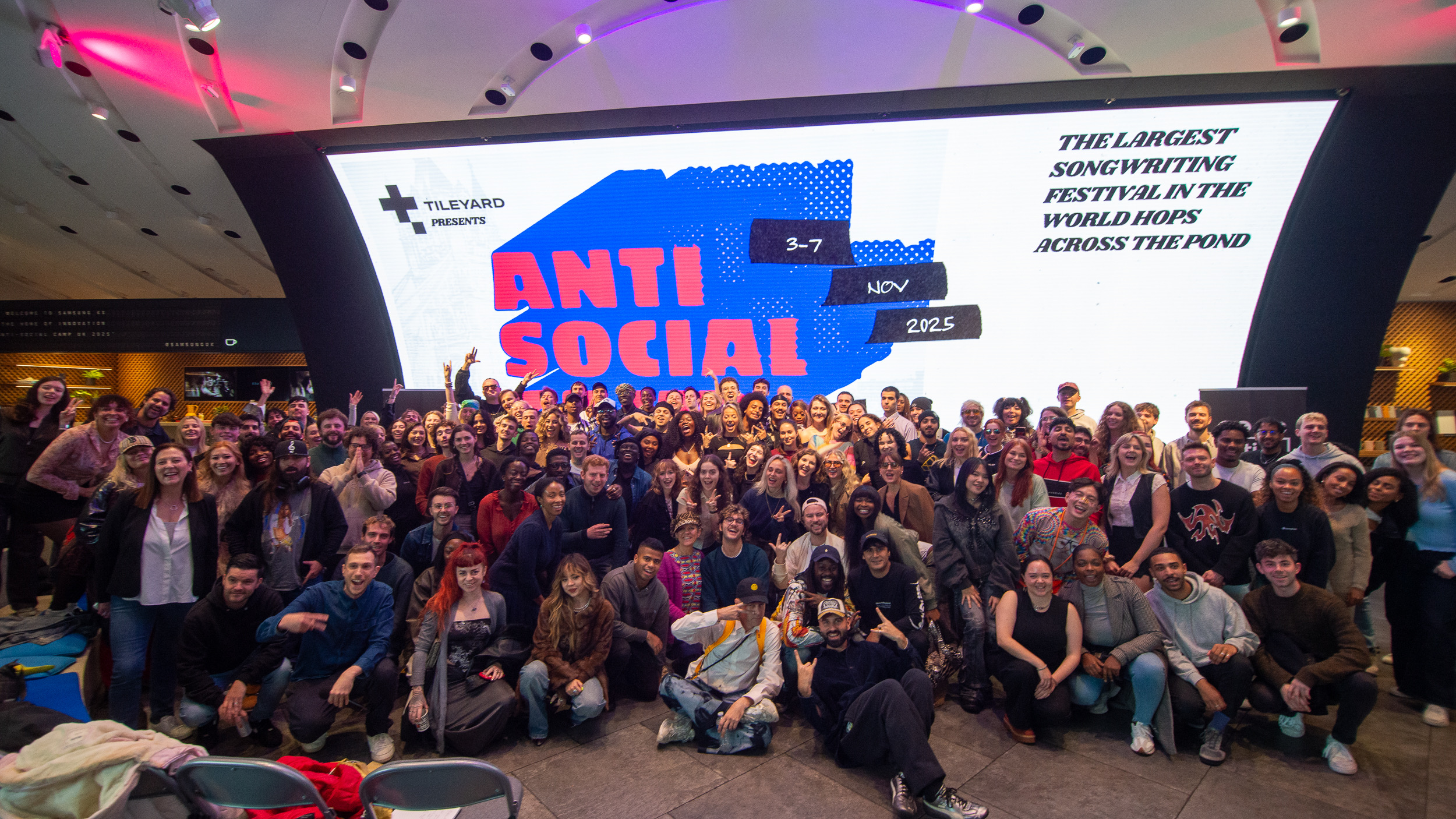
I have friends who have moved to Colombia and Latin America because the dollar stretches a lot further, and there’s a whole artistic scene bubbling up there. And you can’t really create artistic movements when the artists aren’t allowed to live in peace and create. So, that’s what happened in New York, and with Anti Social Camp, one of our original missions has been to bring people back here. Not to integrate politics too much, but Mamdani has just been elected mayor, and his whole message is affordability, with affordability for artists as part of it. So there is a dovetailing of messages. We’ve been screaming, shouting from the rooftops about this for five years now. Hopefully, our festival, which is now the largest songwriting festival in the world, will help to continue to bring people back to New York—not just to live here, but to visit, too.
Accessibility is a key part of Anti Social Camp, since songwriting workshops can be exclusive and expensive. Each time you host Anti Social Camp, does it reinvigorate your own passion for music when you see musicians of all backgrounds come together and create, especially artists who would not have had this opportunity otherwise?
Being part of fostering this community and creating this festival has been the most rewarding experience of my life, outside of having my kids and marrying my wife. It’s unbelievable. By the end of the festival, you’re listening to 200 new songs that had not existed in the world a few days before. And you realize that because we made this effort to create this event, many of these friendships and relationships would not have existed, and many of the opportunities these artists are getting with brands we’re bringing to the table would not have existed. We’re all artists ourselves who organize this, and we created the kind of festival we would want for ourselves. And so, to see that actually play out in the lives of hundreds of people over the years has been unbelievably rewarding.
Depending on the artist and their process, songwriting can be an extremely private endeavor. How does Anti Social Camp create an environment that gets people out of their shells and makes them want to collaborate with other musicians they likely just met that day?
For those who don’t know, most songs in most genres are created collaboratively. Historically, we think of a genius in a bedroom writing songs by themselves and then bringing them in to be produced. And that still exists to some extent, but generally speaking, that is not the model and has not been the model for record-making and song creation for decades now. In general, you have an artist, a music producer, and a songwriter/topliner, usually groups of three, but of course, it can be more, it can be less. All coming together to write the song and make the record, all at the same time, usually in a five to six-hour period. That’s sort of the industry standard.
Songwriting camps have been a newer medium in the pop music landscape, where you’re usually getting 10 to 20 people together to work on one particular brief. And it could be to write the next Rihanna album or the next Kacey Musgraves album, or to write music for a Netflix show. My thinking was, let’s take this concept of the songwriting camp and make it a large, public, front-facing festival, and let’s have 200 recording sessions spread out over 40 different recording studios across New York City. Yes, some people are used to writing alone, even in this new landscape, but who are so grateful that through this event, they have an opportunity to break out of their shell and work with other incredibly talented people.
I was talking with Nathan Sykes, who was part of a big band in the UK called The Wanted, and he was one of our headliners at the London festival. He came up to me and thanked me for using Anti Social Camp as an excuse to get out of his shell, to perform at our events, to write with other collaborators, and to meet a whole new crew of artists, songwriters, and producers that can help with his creative opportunities moving forward.
You’ve now taken Anti Social Camp across the pond. Why did you want to explore the London music scene, and what differences, if any, have you noticed between US and UK-based musicians?
The opportunity came about because there’s an organization called Tileyard in London that is at the center of the UK music scene, and they do everything we do. They have all the recording studios, venues, and a full facility that could host our artist lounge, parties, and events. They are also a management and publishing company, connected with all of the artists, writers, and producers in the UK. We didn’t know anyone in London, and suddenly, we were at the nexus of all the talent and creatives, with everything else we needed to build the logistics of a festival. It was a no-brainer. In theory, it sounded great, but we were curious if we could pull it off. The fact that we did—packed rooms, lines around the corner, and hundreds of new songs created that we’re confident will make their way into the world—was a dream come true. And as a Beatles fanatic, being able to go to the place where my initial musical inspiration came from was personally incredible.
What advice do you have for aspiring songwriters?
We would love to reach as far as we can and support creative communities everywhere without becoming TGI Fridays. We want this to be an extremely curated, bespoke experience that is highly specific for the communities that we’re touching. More than anything, I’ve mentioned that creative communities need to come together. And what I’ve learned from this experience in London is that it’s the same everywhere. That we all need to be supported and that, as creatives, we are similar personalities, no matter where we live in the world. We’re trying to express our voices and create unity with music. And it’s a noble fight. And so, to be able to do that in other cities would be amazing. But we’re a really small team, so we’re going to have to figure out how to get there. But I’m hopeful that someday, Anti Social Camp will be unanimous in bringing together the creative community across the world.
This story first ran in NYOTA’s Music issue. Read more from the issue here and purchase a print copy here.