
You’ve likely seen Malvika Sheth all over your Instagram feed due to her eye-catching outfits. Now, the Los Angeles-based creator is less focused on performing for algorithms and more focused on creating art that reflects a personal evolution. Sheth spoke to NYOTA about her new single “ICONIC,” highlighting South Asian influences on Western fashion, and what we can expect from her in the future.
Recently, you released a dance-pop single called “ICONIC.” What media moments do you think are iconic?
For me, ‘iconic’ moments are the ones that quietly shift culture, not because they’re loud, but because they’re radically honest or pure art. It’s when someone is simply being themselves and doing what they love without trying to make a statement. That’s when self-expression becomes bigger than the person. It’s less about virality and more about meaning. I really believe everyone has iconic energy in them; they just have to unlock it through radical honesty. But I’ll bite. If we’re naming the big, universally iconic moments, Rihanna performing at the Super Bowl while pregnant. Diljit Dosanjh at Coachella. And I don’t know why this comes to mind, but Rekha’s Vogue Arabia cover. So regal.
You have talked about your training in Bharatanatyam contributing to your sense of rhythm and emotional storytelling, and how you were listening to South Asian instrumentation at a young age. What’s your process of blending or using these influences in developing your recent electro/dance pop sound?
You’ll hear South Asian influences woven throughout my music: tabla, mridangam, veena, but always in a way that isn’t forced. My process actually started with sharing specific pieces from my Bharatanatyam repertoire with my producer, and that energy shaped the sound; there wasn’t any piling on instruments for the sake of it. Even when the production isn’t heavy on classical elements, like in “ICONIC,” the culture shows up subtly and naturally in the visuals and in how the story is presented.
Honestly, Bharatanatyam is where I first learned how to express myself. Sometimes in acting I’m told to tone down my expressions – which always makes me laugh, because in Bharatanatyam I grew up hearing the opposite: ‘More expression! The audience needs to feel it in the back row!’ That training taught me to tell emotional stories with my whole face, my body, my spirit. It’s an instinct that carries into everything I create, from content to acting to my music. I can’t make a song without wanting to tell a deeper emotional story, both lyrically and visually. That 360-degree approach comes from Bharatanatyam.
Some of your fashion content includes hacks for incorporating dupattas in everyday wear, like this sleeve hack or this flower knot hack. What is your favorite everyday Indian accessory, and what is some advice you have for people who want to incorporate South Asian styles in their everyday wear?
Right now I’m in nostalgia mode, “ICONIC” was released on my late grandfather’s birthday, so I’ve been thinking of him and my late grandmother. As such, I’m currently drawn to my late grandmother’s bangles, the ones you see on the “ICONIC” cover. They’re simple, clear, with a bit of sparkle. Wearing them feels like carrying both of them with me, and it reminds me of who I am, no matter where I go, Paris Fashion Week or a Diwali party. For anyone wanting to incorporate South Asian elements, choose pieces that genuinely speak to you. Your style should feel like an extension of your story, not a trend. Use what feels authentic to your lifestyle and your identity.
You have many videos using Indian accessories to reimagine runway looks, like recreating the Miu Miu embellished vest with jhumkas and chandbalis or using Bharatanatyam flowers similarly to Jacquemus’s flowers. Your content makes it clear that South Asian influences in Western fashion are abundant. What is your favorite example of this intersection that you’ve seen on the runway?
There’s so much dialogue around cultural inspiration right now, and my take on it is that inspiration can be beautiful when it’s done with respect and credit. Actually, instead of focusing on the usual big names, let me highlight South Asian designers making incredible contributions to Western couture and RTW. Rahul Mishra’s couture show in Paris was unforgettable — his craftsmanship is unreal. I attended last year in the summer, but I still can’t stop thinking about it. Also, I was backstage at FALGUNI Shane Peacock’s NYFW show a couple of seasons ago, the show under Law Roach’s creative direction, which was another moment that felt truly iconic. I loved how they used chunky bangles on the runway.

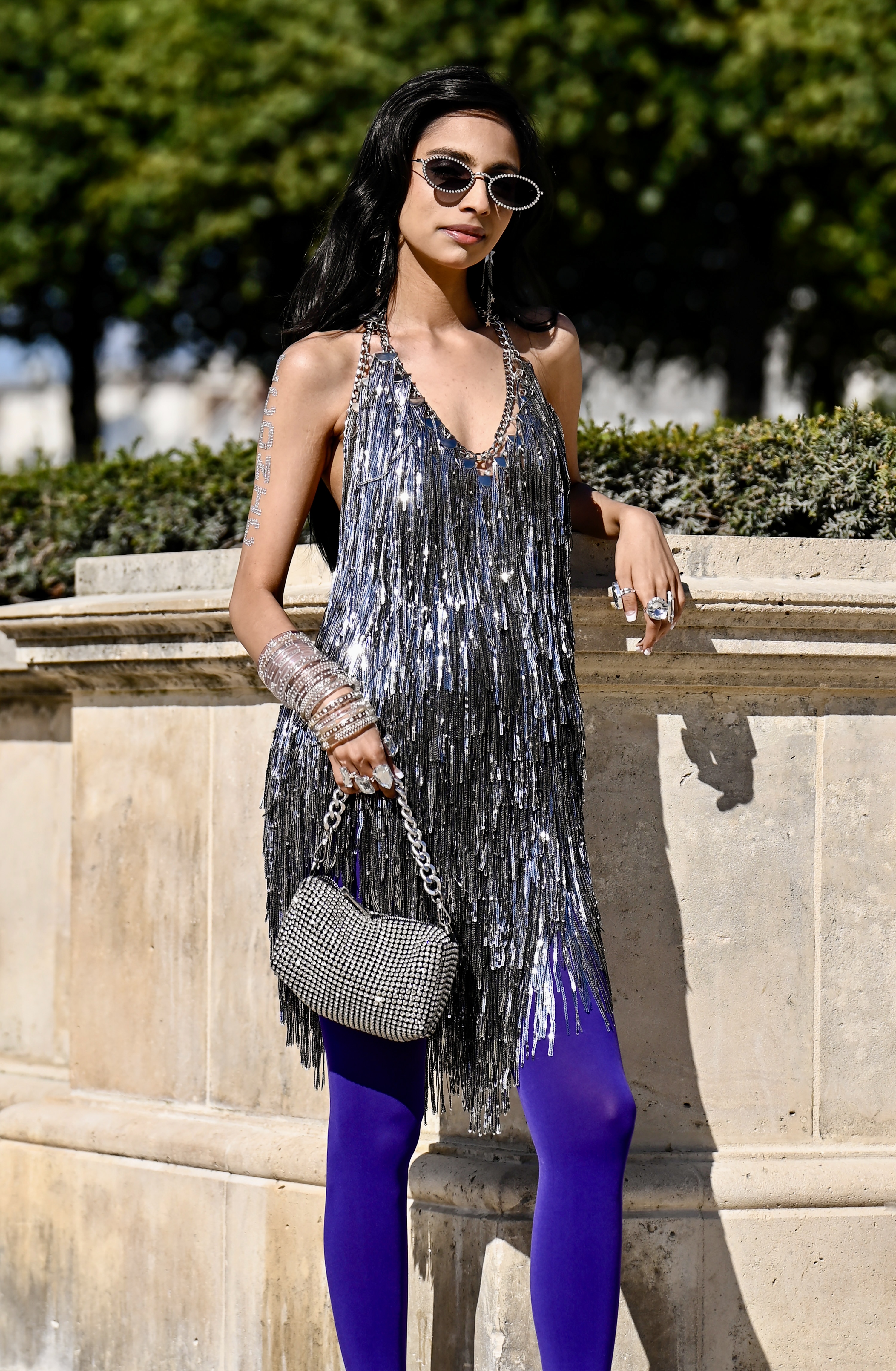
I loved your Paris Fashion Week street-style look– the silver Kelsey Randall fringe dress, Miu Miu heels, the bedazzled bag, the bangles, and the rhinestones spelling out “ICONIC” on your arm – a clear reference to your single. You similarly advertised your single “Spiraling” with your New York Fashion Week dress in September. What is your process of conceptualizing your music in your fashion?
It always starts with the music. The moment I finish a song, I literally go into a visual spiral — I’m on Pinterest for hours making moodboards, staying up all night pulling runway references, searching for archival pieces, anything that matches the emotion of the track. Fashion and music have become inseparable for me. Every song gets its own world: for “ICONIC,” it was diamonds, glam, disco sparkle; for “Spiraling,” it was anything with spiral motifs. Six years in fashion has given me the privilege of being able to source/loan pieces from brand partners that help bring my visuals and artistic world of each track to life, and I love merging both worlds into one artistic experience.
“ICONIC” dives into your journey of reclaiming your artistic identity after years of content creation. How do you navigate this balance of creating art that is true to yourself as an artist while maintaining success as a digital creator?
Right now, my focus is on maintaining success as an artist, not just as a creator. Even changing my handle from @stylebymalvika to @malvikaonline was part of that shift. I wanted my online identity to reflect me as a whole artist, not just the “style” box I was put in. I’ve always been an alchemist at heart… I take whatever I’m feeling and try to transform it into something beautiful, whether that’s clothes, a character, or with music. I don’t share everything I go through, but my art is where some of it lives. I took a break from posting on IG after releasing “ICONIC” because I couldn’t perform for an algorithm anymore. My sustainability comes from honesty. My value comes from depth, sensitivity, and storytelling. Until I can share something that reflects that, I’m okay with silence.
As an Indian American content creator that was making fashion content amid trends like “Scandinavian scarves” and “Boho style” – which both appropriated South Asian fashion – how do you navigate the obstacles of creating on social platforms that seem to reward appropriation?
I definitely see those moments where South Asian fashion gets renamed or repackaged, like the “Scandinavian scarf” trend, kind of wild. I’d rather stay grounded in authenticity. In my video, I guess I just quietly called it what it is: an Indian scarf. It’s a dupatta. That felt like the cleanest way to correct the narrative without adding noise. In hindsight, I could’ve been even broader with the term, because the dupatta isn’t exclusive to India; it’s worn across South Asia. But I was still glad I was able to shift the language back toward the truth. For me, it’s less about policing trends and more about representing my culture clearly and respectfully in whatever I put out.
What can we expect to see from you in the future? Are you working on any exciting upcoming projects?
2026 is going to be a big year, both in acting and (I’m hoping also) for music. I’m still rooted in fashion, but now everything flows from my artistry. I’m done hiding behind trends or hacks. I won’t say I’ll never do them again, but those won’t be my focus. I want people to know my voice, my depth, my softness, my contradictions, my humor…the full me. For years, I felt boxed in by what “worked” online. This next chapter is about showing who I really am through the art I create and hopefully bringing people into a visual world that complements my music.